

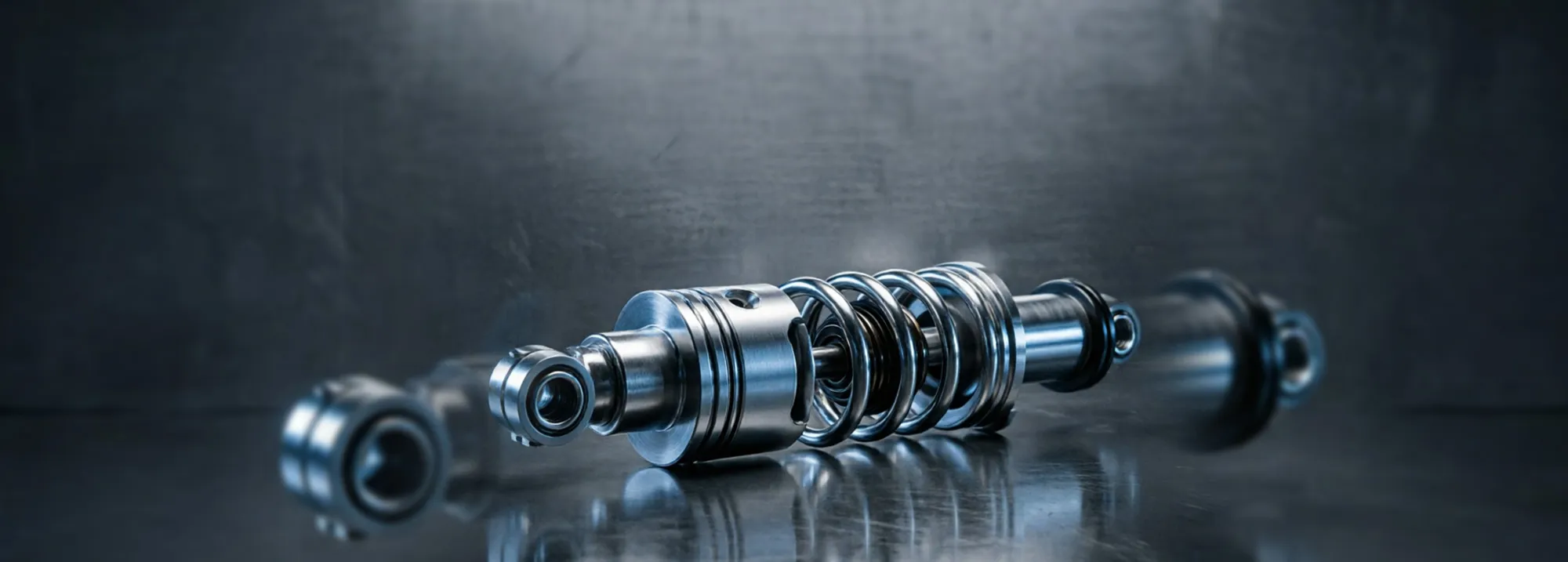
Tesla owners love instant torque and precise steering, but many Model 3 and Model Y drivers still complain about the same thing: the factory suspension can feel too stiff on broken roads, speed bumps, and daily commutes. Our Tesla magnetic rheological suspension solves this by making the damper smart. Instead of one fixed setting, the system reads the road thousands of times per second and continuously adjusts damping force—soft when you want comfort, firm when you want control.
Magnetic rheological suspension, also known as MRC or magnetorheological damping, uses a special fluid filled with microscopic magnetic particles. Inside each damper, a coil creates a controllable magnetic field. When the field changes, the particles align into chains almost instantly. This changes the fluid’s apparent viscosity and therefore the damping force.
The reaction is not mechanical like a traditional valve. It happens in milliseconds. The system can recalculate damping up to 1,000 times per second, so the suspension responds before the body has time to bounce or roll excessively. [5,10](@ref)
The complete system includes four core parts:
MR fluid: magnetorheological fluid that changes stiffness under magnetic field.
MR dampers: direct-replacement struts and rear shocks designed for Tesla chassis geometry.
ECU module: reads acceleration sensors, gyroscope data, vehicle speed, steering, braking and CAN-bus signals.
Control modes: Comfort, Standard and Sport profiles selectable from the cabin, without manual wrench adjustment.
When a sensor detects a bump, hard braking or fast cornering, the controller sends current to the damper coil. More current means a stronger magnetic field, higher fluid resistance and firmer damping. On smooth roads, current drops and the ride becomes softer. The whole process is automatic and continuous.
Tesla platforms are heavy because of the battery pack. That weight improves stability but also increases body pitch, squat and roll. A passive shock absorber cannot tell the difference between a pothole, a corner and a highway expansion joint. Our MRC kit gives the chassis adaptive intelligence.
Over speed bumps and rough pavement, damping softens instantly. Impact is absorbed instead of being transferred straight to the cabin. Passengers feel less secondary bouncing, which also reduces motion sickness in the rear seat.
During lane changes, spirited driving or emergency avoidance, the outer dampers firm up. Body roll is reduced, tire contact is maintained, and steering feels more predictable.
During hard acceleration, the system increases rear damping to limit squat. Under braking, front damping increases to reduce nose dive. The car stays balanced instead of pitching forward and back.
Choose Comfort for commuting, Standard for everyday driving, and Sport for mountain roads or higher-speed stability. The hardware does not change; only the control strategy changes.
We focus specifically on Tesla-compatible magnetic suspension systems, not generic shock absorbers. Our development process covers MR fluid formulation, damper sealing, coil drive electronics, vehicle dynamics calibration and real-road validation.
Each application is tested for:
Damping response time across low and high road frequencies.
Sealing durability, including long-term pressure, temperature and oil-leak checks.
CAN communication stability with Tesla vehicle signals.
Installation compatibility with factory mounting points, no cutting or welding required on supported models.
We also provide installation guidance, torque specifications, sensor leveling checks and post-install road testing procedures. Proper installation matters as much as the hardware itself.
The current Tesla magnetic rheological suspension program is engineered for:
Tesla Model 3 — including standard range, long range and performance variants by year.
Tesla Model Y — including RWD, AWD and long range configurations.
Fitment varies by market and production year. Before ordering, we verify VIN-specific mounting, sensor layout and electronic configuration to avoid mismatch.
Passive shocks: affordable, but damping stays fixed. Good for one driving style only.
Coilovers: adjustable, but usually needs manual tuning. Comfort and handling still involve compromise.
Air suspension: good height flexibility, but adds compressors, lines and maintenance risk over time.
Magnetic rheological suspension: active damping, millisecond response, no mechanical valve delay, and automatic adaptation to load, speed and road condition.
Tesla is a high-voltage vehicle. Suspension work should be performed by technicians familiar with EV safety procedures. Before lifting the car, the system should be placed in service mode where applicable, and the suspension must be torqued under simulated ride-height conditions.
After installation, we recommend:
Low-speed test for abnormal noise, pulling and smooth damping transition.
Mid-speed test for cornering support and mode switching.
High-speed test for straight-line stability and emergency lane change response.
Alignment check to confirm camber, toe and ride height are within specification.
A short break-in period helps the bushings and dampers settle. Regular inspection every few thousand kilometers keeps the system reliable.
We are not a generic marketplace reseller. Our team works directly on Tesla suspension applications, from product validation to installation support. Every kit is checked for fitment, electrical compatibility and damper performance before shipment.
Customers receive:
Model-specific configuration instead of one-size-fits-all dampers.
Technical documentation for installers and tuners.
After-sales support for diagnostics, mode calibration and warranty handling.
B2B availability for shops, distributors and regional installers.
No. Softness is only one mode. In Sport mode, damping can be firmer than many factory settings. The advantage is that the car no longer stays hard all the time—it becomes soft only when the road asks for it.
Depending on the model, we supply complete strut assemblies or damper-only units. Complete assemblies are faster to install and reduce variation between left and right sides.
In many applications yes. The magnetic damper works with the existing spring geometry, while the electronic control handles damping. Spring rate changes are optional, not required.
Reliability depends on seal design, fluid stability and correct installation. Our dampers use upgraded sealing structures and validated MR fluid to reduce settling, leakage and performance drift.
The Tesla magnetic rheological suspension is not just a softer shock absorber. It is an active chassis upgrade that balances comfort, control and safety in real time. For Model 3 and Model Y owners who want the sharp Tesla steering but not the harsh daily ride, MRC is one of the most effective upgrades available.
If you want a suspension that thinks instead of just absorbing, this is the direction worth choosing.
Ready to upgrade? Contact our team with your Tesla model, year and VIN. We will confirm fitment, recommend the right damping profile, and provide installation support for your region.