

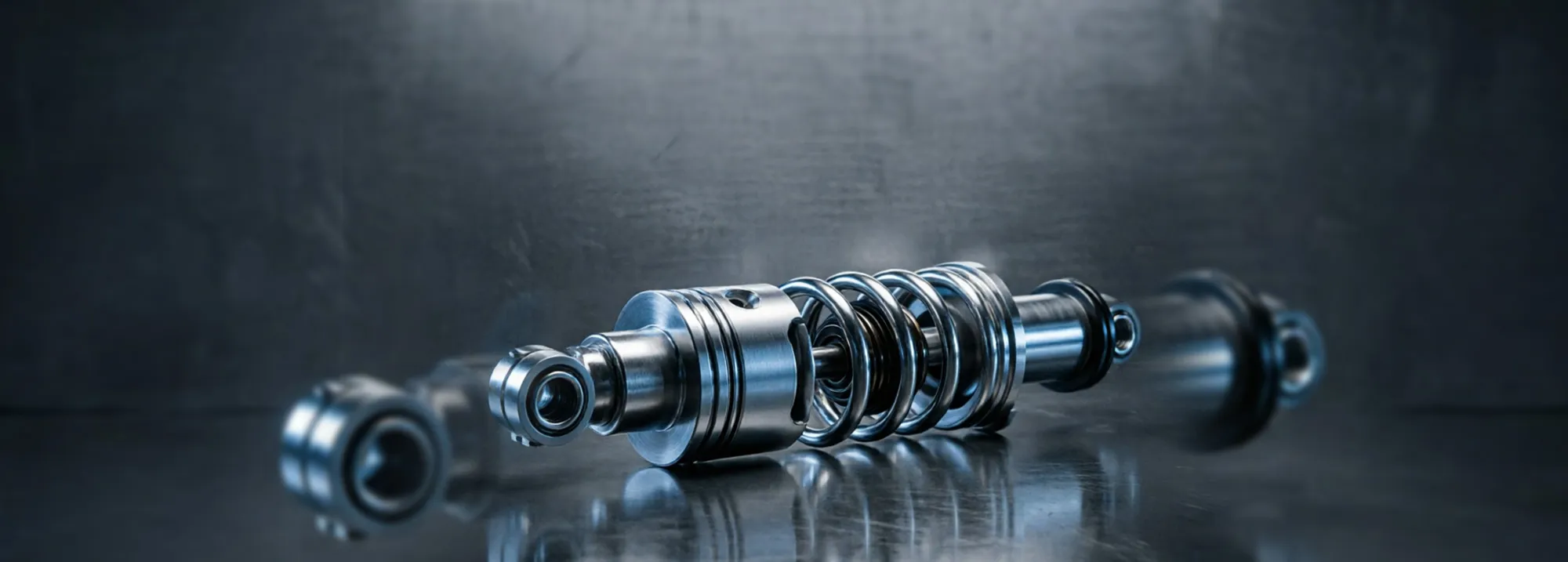
Summary: The Tank 300 magnetorheological (MR) suspension is a semi-active damping upgrade that replaces the factory hydraulic dampers with magnetically controlled units capable of adjusting damping force in milliseconds. This article covers the working principle, verified performance data, product variants, compatibility considerations, and maintenance expectations for Tank 300 owners evaluating an MR suspension upgrade.
The Tank 300 is built on a body-on-frame chassis with a double-wishbone independent front suspension and a multi-link live rear axle[reference:0]. This architecture delivers genuine off-road capability, but the factory damping setup is a compromise: it must manage paved-road comfort, high-speed stability, and heavy off-road articulation with fixed or mechanically variable valving. For owners who use the vehicle across mixed terrain—daily commuting, mountain roads, sand, and rocky trails—that compromise becomes noticeable.
Magnetorheological suspension addresses this limitation directly. Instead of fixed or manually selectable damping curves, MR dampers use a magnetorheological fluid whose viscosity changes almost instantly when a magnetic field is applied. The result is a suspension system that can stiffen for cornering and load control, then soften for washboard roads and trail impacts, without driver intervention.
MR fluid contains micrometer-scale magnetizable particles suspended in a carrier fluid. When an electromagnetic coil inside the damper is energized, the particles align into chains, increasing the fluid’s yield stress and therefore the damping force. When the current is reduced, the fluid returns to a lower-viscosity state. Because the change is electrically controlled rather than mechanically valved, response is measured in milliseconds.
In Tank 300 MR suspension systems currently available in the aftermarket, the dampers are managed by a controller that reads vehicle body motion, wheel inputs, and road conditions, then adjusts current to each damper independently. This four-corner independent control is what allows the system to suppress pitch under braking, reduce roll in corners, and absorb trail impacts without transmitting them through the chassis.
Among the MR suspension systems developed specifically for the Tank 300, the most extensively documented platform is the Menggerui Ultra MagRheo system from Chaoshan Technology (朝上科技). The following figures come from the manufacturer’s public technical disclosures and independently reported field results.
These figures are specific to the Menggerui/Chaoshan platform. Other MR kits entering the Tank 300 market may publish different numbers, and buyers should request dyno data and vehicle-specific validation records for any system under consideration.
The Tank 300 MR aftermarket currently offers distinct tuning variants rather than a single universal calibration. The two most clearly defined are the General Version and the Desert Version.
A third category—high-performance coilover-style MR kits with larger damper bodies—has also entered development and commercialization for the Tank 300, aimed at owners running heavier wheel-and-tire packages or frequent high-load off-road use.
The Tank 300 uses a 6×139.7 PCD wheel bolt pattern with a 100 mm center bore, a common off-road configuration that supports a wide range of aftermarket wheels[reference:10]. MR suspension kits are designed to work with the factory mounting points, but the following factors should be confirmed before purchase.
MR dampers have a longer engineering pedigree than many buyers realize. Military-application MR dampers have passed 4 to 5 million fatigue cycles and 15,000 miles of off-road durability testing, with reported durability four to five times that of conventional dampers in those test regimes. Automotive MR fluid and damper durability have also been validated over multiple production programs and decades of accelerated testing[reference:15].
That said, MR suspension is not maintenance-free in the same way as a simple hydraulic shock. The MR fluid is sensitive to contamination and temperature extremes, and the damper seals and coil assemblies represent additional service items compared with a passive shock[reference:16]. Replacement cost per corner, if a damper fails out of warranty, is higher than a conventional replacement—frequently exceeding the cost of a standard shock by a significant margin[reference:17]. Prospective buyers should factor this into total cost of ownership rather than treating the MR system as a zero-maintenance upgrade.
Is magnetorheological suspension standard equipment on the Tank 300?
No. Factory Tank 300 configurations list conventional suspension without electromagnetic or MR damping as standard; MR systems are currently offered through the aftermarket and specialty upfitters[reference:18][reference:19].
Can the MR system be installed without changing the vehicle’s ride height?
Yes. Stock-height MR replacement kits exist. Lift-coilover MR kits are also available for owners who want additional clearance, but those installations require separate consideration of alignment, control-arm geometry, and regulatory compliance.
Does MR suspension eliminate the need for manual drive-mode selection?
In systems with road-surface recognition, the controller can identify surface type and switch damping algorithms automatically, reducing or removing the need for the driver to manually toggle between comfort and sport or off-road modes[reference:20].
How does MR compare with conventional nitrogen dampers for off-road use?
Conventional nitrogen dampers offer predictable performance and rebuildability, but their damping curve is fixed once valved. MR dampers can vary damping force within milliseconds across the full operating range, which is particularly advantageous on mixed surfaces and during rapid transitions between loaded and unloaded states. In the 4X4SPORT competition result cited above, the MR-equipped Tank 300 finished ahead of nitrogen-damper-modified vehicles, though competition outcomes also reflect driver skill, tire choice, and vehicle preparation[reference:21].
The Tank 300 MR suspension category has moved from concept to commercially delivered product, with documented response times under 5 ms, surface-adaptive control, and field validation in sand and competition environments. The technology is a credible upgrade for owners who want one damping setup that can shift character between daily driving and demanding off-road use. The key purchasing decisions are calibration (General versus Desert), ride-height intention (stock replacement versus lift), and acceptance of the higher long-term service cost relative to a passive damper. Buyers should request vehicle-specific validation data and confirm regulatory compliance for their region before committing to installation.